In short. Local SEO puts your firm on the map and in local results. GEO gets your firm quoted by AI assistants. Both rest on the same base: accurate information, consistent everywhere, and content that answers your clients' real questions.
1. The three places clients search
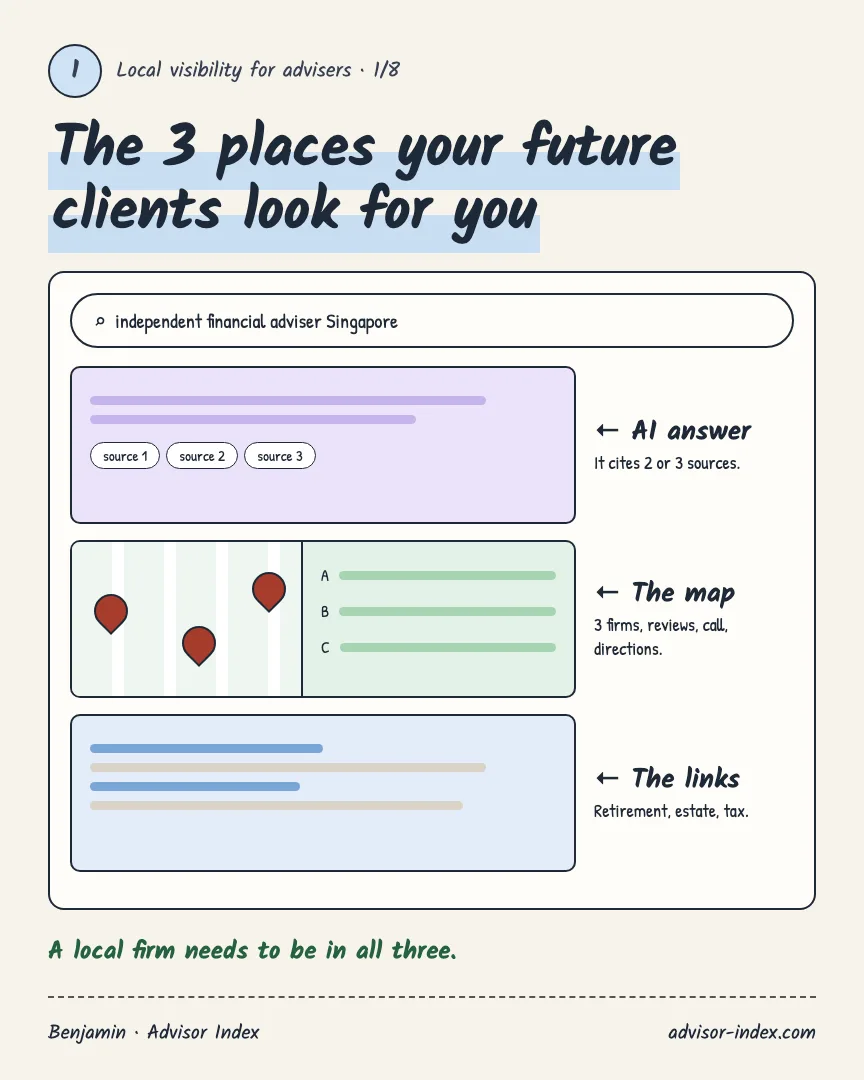
- AI answers (ChatGPT, Gemini, Perplexity, Google's AI Overviews): they summarise and quote a handful of sources.
- The map: a few firms shown with their reviews, a call button and directions.
- Ordinary results: the considered searches on retirement, estate planning or tax.
2. The searches that bring clients
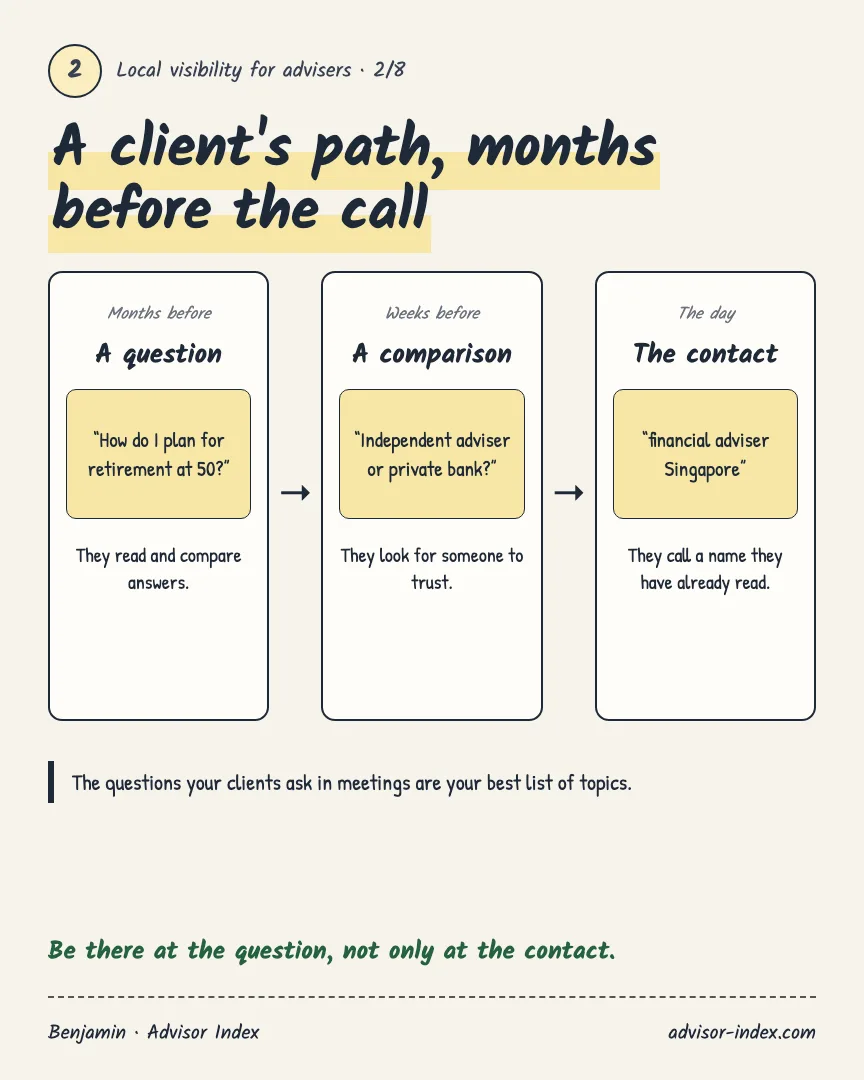
For an advisor, the question usually comes months before the call. A future client goes through three kinds of search: a question (retirement savings, passing on wealth), then a comparison (independent advisor or private bank, what an advisor costs), then a contact search with the name of their town. A firm that only shows up at the last step arrives after the others. The questions your clients ask in meetings are the best list of topics.
3. The Google Business Profile
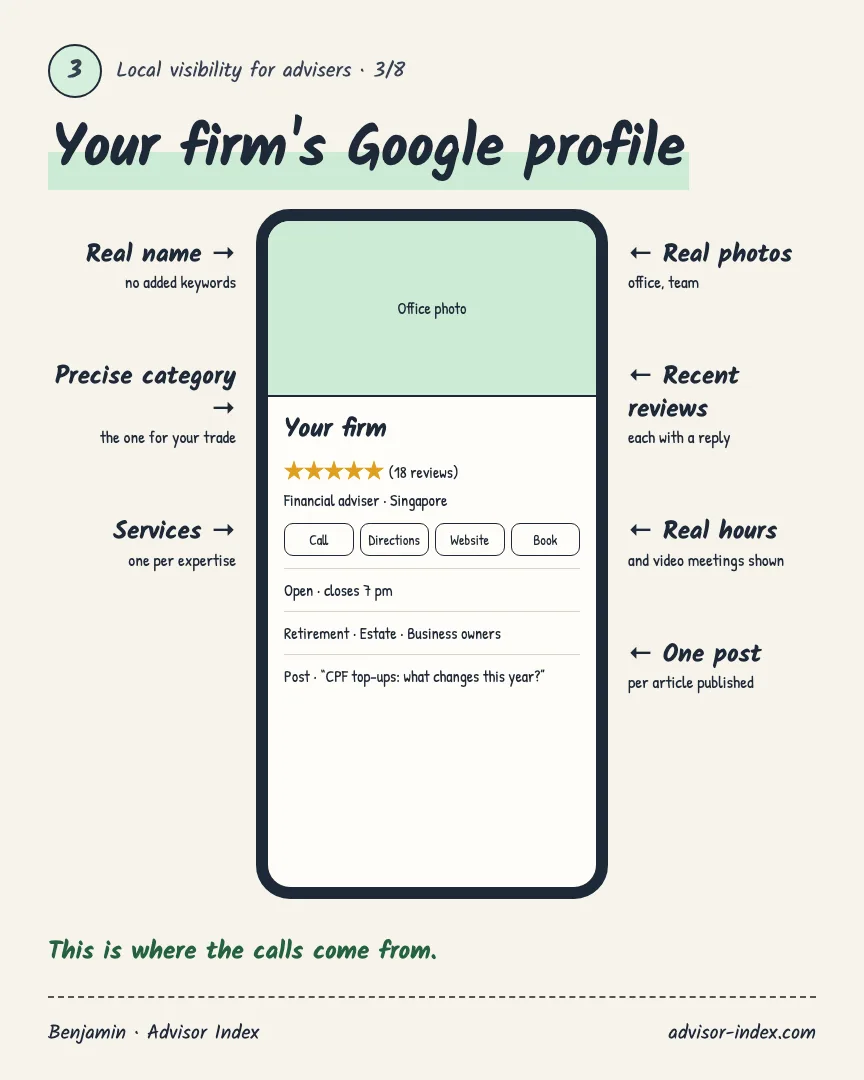
- The real name of the firm, with no keywords added.
- The most precise primary category for your work, and secondary categories for your other activities.
- One service per area of expertise, each described in one sentence.
- The exact address and the towns you serve.
- Real opening hours, including evening or video meetings if you offer them.
- Real photos of the office and the team.
- A post for each article you publish.
- Recent reviews, each with a reply.
Three rules specific to advisors: never confirm in public that someone is a client, never give advice or case details when replying to a review, and never promise returns.
4. A website search engines can read
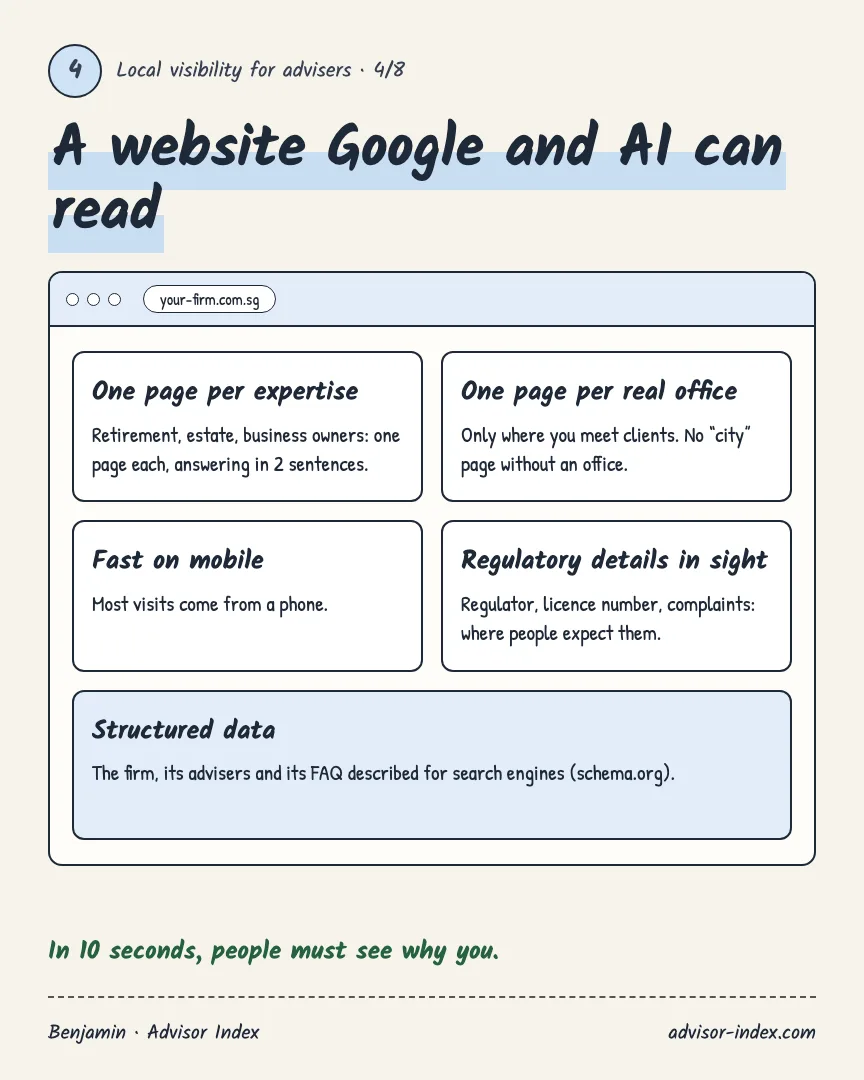
One page per area of expertise, one page per office that is actually open to the public, and nothing more: no page for a town where nobody meets clients. The site must be fast on mobile, show its regulatory information clearly, and describe the firm, its advisors and its FAQ in structured data.
5. Content people can trust
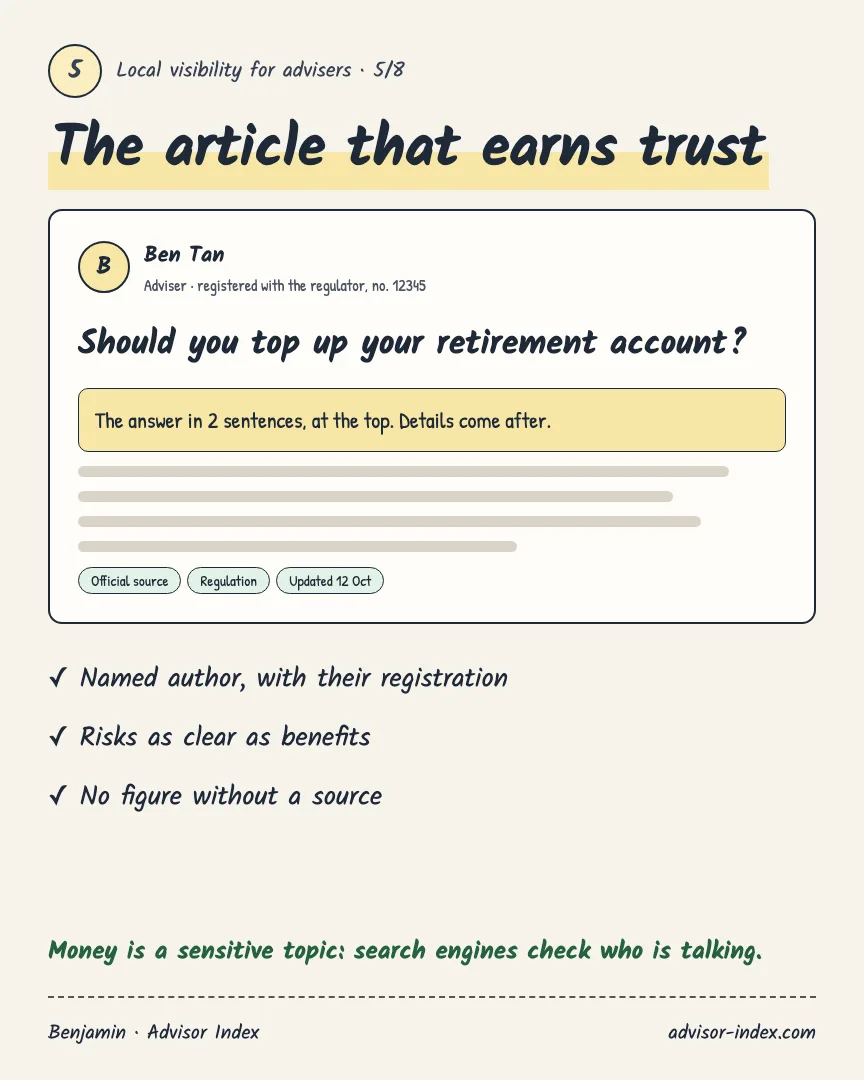
Money is a sensitive topic for search engines: they look for proof of experience, expertise, authority and trustworthiness. Each article carries the name of its author, their background and their registration number with the local regulator. It cites official sources, shows risks as clearly as benefits, and only uses figures that are sourced and current.
6. Reviews, directories and links
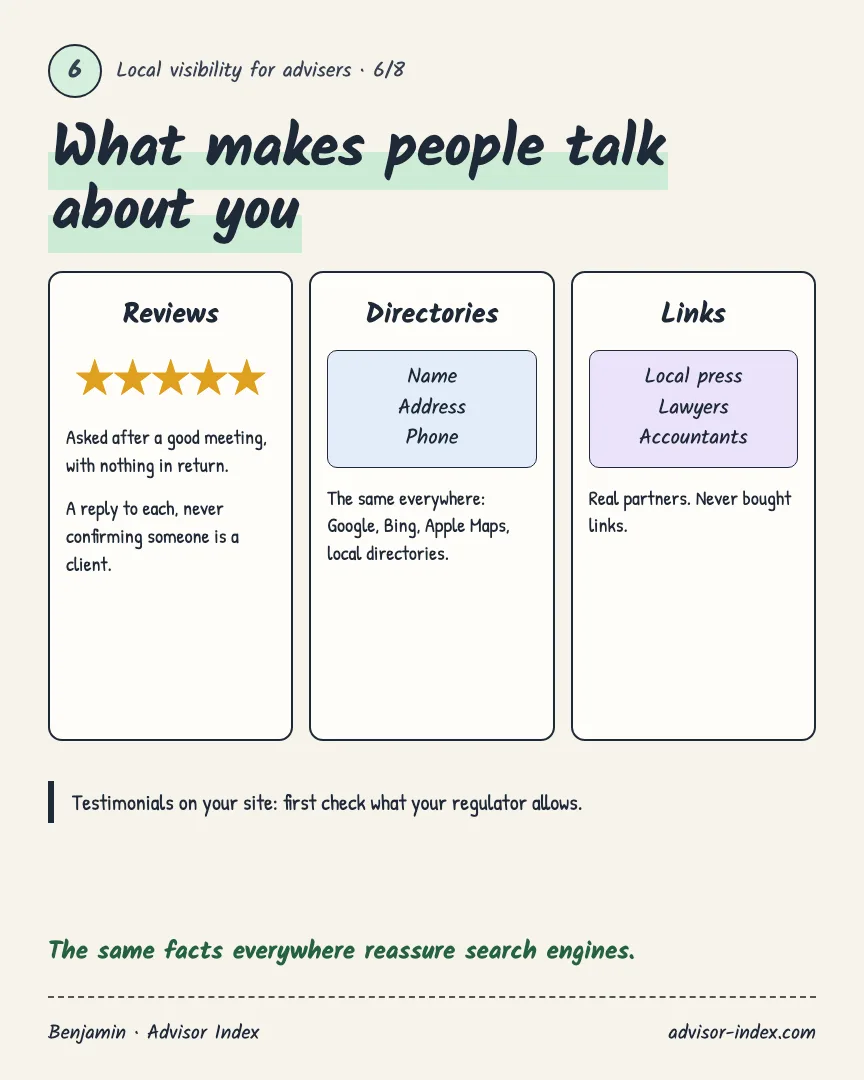
- Reviews: ask after a good meeting, with nothing in return, and reply to every one.
- Directories: the same name, address and phone number everywhere (Google, Bing Places, Apple Maps and the directories of your country).
- Local links: local press, business clubs, partner accountants and notaries. Never bought links.
Before showing testimonials on your site, check what your regulator allows: the rules differ by country.
7. Being quoted in AI answers
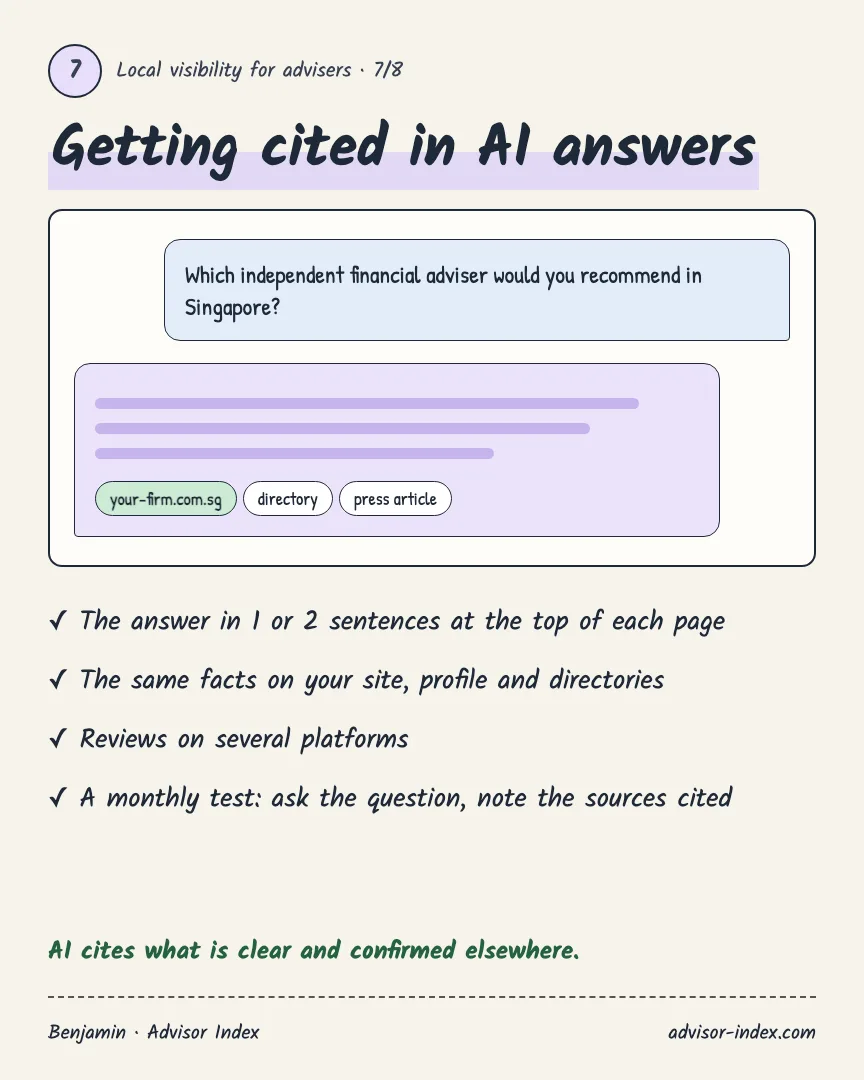
AI assistants with web search read pages, then quote those that answer clearly and whose facts match other sources. Put the answer in one or two sentences at the top of each page, keep the same information everywhere, and collect reviews on more than one platform. Test it yourself every month: ask "who is the best independent wealth advisor in [your town]?" and look at the sources quoted.
8. How long, and what to track
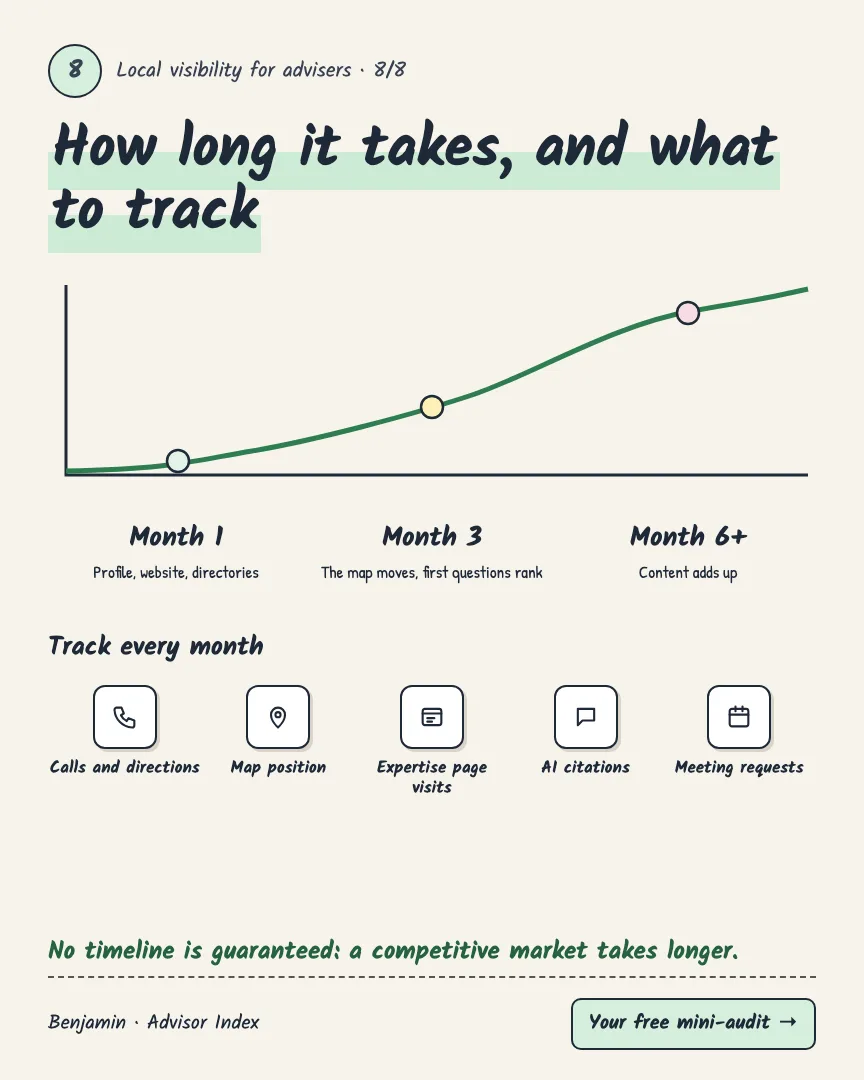
The profile, the website and the listings come first. Movement on the map and on the first questions usually follows within a few months, then content keeps adding up. Each month, track calls and direction requests from the profile, your position on the map, visits to your expertise pages, mentions in AI answers and meeting requests. No timing can be guaranteed: a competitive market takes longer.
Frequently asked questions
What is local SEO for a wealth advisor?
Local SEO is what makes your firm appear when someone near you searches for an advisor: on the Google map, in the ordinary results and in the answers of AI assistants. It rests on a complete Google Business Profile, a clear website and consistent information everywhere your firm is listed.
What is GEO?
GEO (Generative Engine Optimization) is the work that makes AI assistants such as ChatGPT, Gemini, Perplexity or Google's AI Overviews quote your firm in their answers. They favour pages that answer a question clearly and whose facts match what other trusted sources say about you.
How long does it take?
Several months. The profile, the website and the listings are set up in the first month; visible movement on the map and on the first questions usually comes after that, and content keeps adding up over time. No one can guarantee a position on Google or in an AI answer.
Are the rules the same in every country?
No. Regulators, protected titles, the rules on reviews and testimonials, and the directories that matter all differ from one country to another. Each country page explains its own rules.
Your country
Regulators, titles, review rules and directories change from one country to another. Country pages open progressively: French-speaking Switzerland first, then Belgium and Canada.
We set this method up for independent advisers, in their country and language: see our services and prices, or start with the free mini-audit. Contact: contact@advisor-index.com